











































You approve a fixture schedule, the install goes clean, and then you walk the finished space, and the merchandise looks flat, the paint samples read “off,” and the fresh produce in the deli case looks a day old. Nothing’s broken. The lights are bright, and the color temperature is right. So what happened? Nearly always, the cause of any problem with accurate color rendition is a case of CRI lighting, or its absence in properly selected LED lighting solutions. To the professional purchasing agent, trades contractor, and facilities manager, the one figure that determines how well colors are rendered correctly is the color rendering index.
This guide is written for people who write purchase orders, not decorate bedrooms. We’ll break down what CRI lighting actually measures, how to read a CRI rating in seconds, why CRI vs lumens and CRI vs color temperature trip up even seasoned specifiers, and where high CRI lighting is worth the premium versus where it’s overkill. Get this right, and you avoid the expensive callbacks, returns, and “the color looks wrong” complaints that quietly eat into margins on commercial projects.
Key Takeaways
- CRI (color rendering index) is a 0–100 score for how accurately a light source shows an object’s true colors compared to daylight.
- A CRI rating of 80 is the commercial baseline; 90+ is high CRI lighting, and 95+ is reserved for the most color-critical work.
- CRI vs lumens vs color temperature cover three different aspects: precision, brightness, and color warmth- and there is no substitute for any of them.
- For true LED color accuracy, you should move beyond the advertised figure to R9 ratings and TM-30 data, which can slip through the cracks with CRI alone.
- It’s all about picking the correct rating for the job; a warehouse and an art gallery have entirely different requirements.
What Is CRI Lighting and Why Does Color Accuracy Matter?
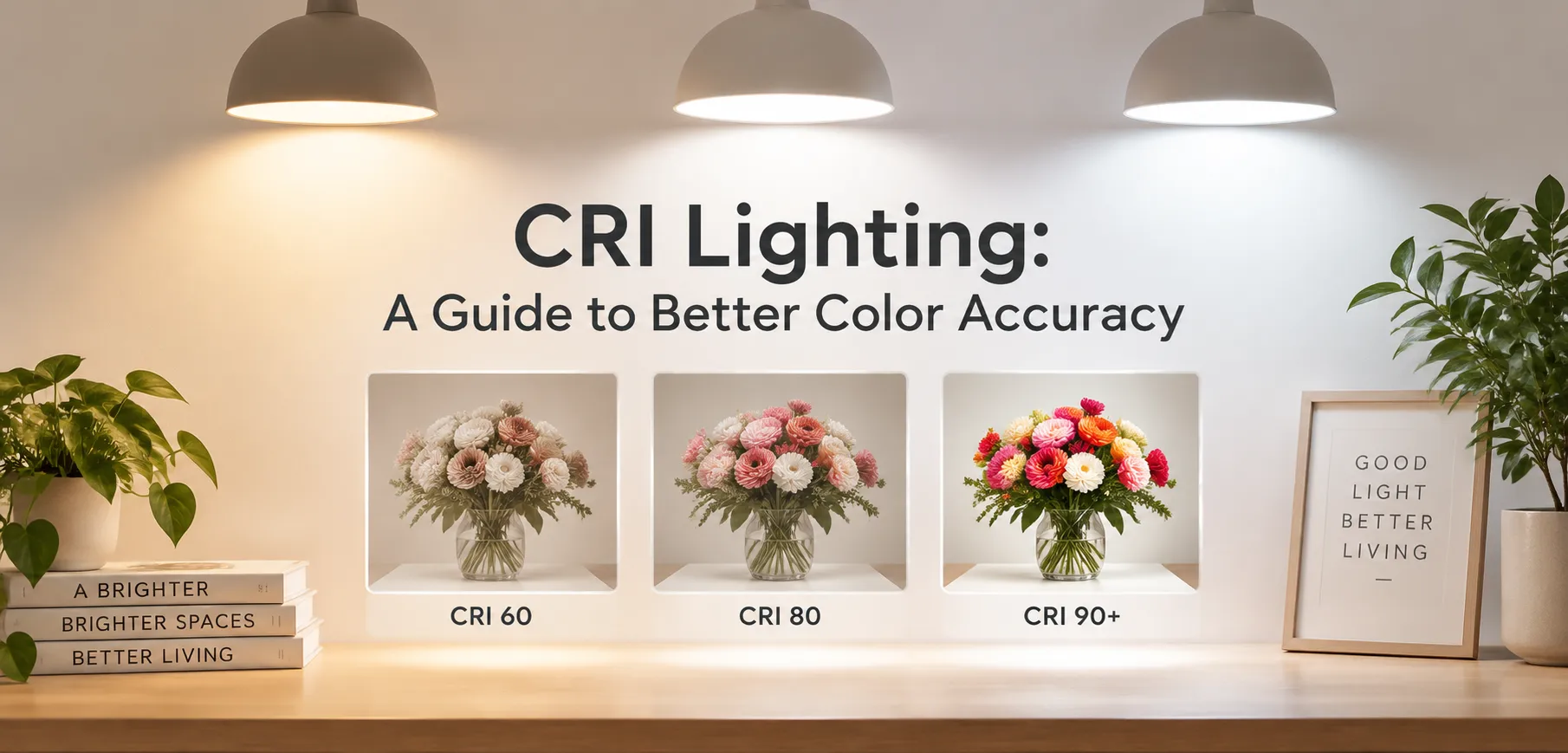
The most basic definition of the color rendering index is that it measures how accurately objects appear under a light source compared with a reference source of the same color temperature. The result is the CRI rating between 0 and 100; this means the colors will look exactly how they look in natural daylight. The lower the score, the more the colors will change, fade, and be difficult to distinguish. Practically speaking, CRI lighting is the difference between “this is the right color” and “this is okay.
Why does this matter commercially? Because light color rendering touches everything your clients care about seeing correctly. If the lighting conditions in the salon or the doctor’s office have low CRI lighting, then skin will be sallow; in the designer’s office, color samples of the printed material will change; in the showroom, wood grains and cloth samples will be deceptive, and products packaged for impulse buys will lack their appeal. The right indoor lighting with a high CRI rating ensures that meat appears fresh, paint samples match accurately, and product packaging maintains its intended appearance.
How to Read CRI Ratings: 70, 80, 90 and 95+
You don’t need a lab report to make a smart first cut; you need to know what each band of the scale delivers. The table below turns the CRI rating into an actionable guide so you can match CRI lighting to the job instead of defaulting to whatever’s cheapest.
| CRI Rating | Color Quality | Best-Fit Applications |
| Below 70 | Poor: colors look dull, similar shades blur together | Rarely acceptable; back-of-house, utility rooms, some outdoor/security areas |
| 70–79 | Fair: noticeable color distortion | Parking structures, storage, non-color-critical circulation |
| 80–89 | Good: the commercial standard; most colors render well | Offices, general retail, schools, corridors, warehouses |
| 90–94 | Excellent: colors are vivid and true (high CRI lighting begins) | Upscale retail, hospitality, healthcare, showrooms, food service |
| 95–100 | Reference-grade: near-perfect LED color accuracy | Galleries, print/paint matching, photo/video, luxury merchandising |
In summary: A CRI rating of 80 is the bare minimum for most commercial interior spaces, while anything that goes beyond that with a CRI value above 90 qualifies as a high-CRI LED light. It is only when the color quality in lighting is high that people can tell the difference, and the upgrade is worth it the minute color affects sales, diagnostics, branding, and performance evaluation.
CRI vs Lumens vs Color Temperature: What Each Tells You
Here’s the confusion that costs specifiers the most: assuming one number tells the whole story. It never does. A fixture can be blindingly bright and still render color poorly. It can be a cozy warm white and still be inaccurate. CRI vs lumens and CRI vs color temperature are not competing specs; they’re three separate answers to three separate questions, and you need all three to judge LED lighting quality.
| Lighting Metric | Measures | Unit / Scale | Main Question |
| CRI (color rendering index) | Color accuracy | 0–100 | Will colors look true? |
| Lumens | Total light output (brightness) | Lumens (lm) | How much light is there? |
| Color temperature (CCT) | Warm vs. cool appearance | Kelvin (2700K–6500K) | Does the light look warm or cool? |
Think of it this way. Lumens tell you how much light fills the space. Color temperature helps define the visual feel of a space: 2700K creates a warm atmosphere, while 5000K provides a brighter daylight-like appearance. And CRI lighting tells you whether the objects under that light show their real colors.
A 5000K, 4000-lumen panel with a 75 CRI rating will be plenty bright and nicely neutral, and still make your client’s teal display look gray. That’s why CRI vs lumens matters: brightness measures output, while CRI determines how accurately colors appear. And CRI vs color temperature matters just as much: two 3000K bulbs can have wildly different light color rendering depending on their CRI. Spec all three deliberately, every time.
Where High CRI Lighting Makes the Biggest Difference
Not every project needs 90+, and specifying it everywhere wastes budget you could put toward efficiency or controls. The smart move is to grade the requirement by how color-sensitive the environment is. The table below maps CRI lighting priorities across common commercial and industrial settings so you can right-size the spec.
| Application | Suggested CRI | Priority | Why |
| Warehouses/distribution | 80+ | Moderate | Visibility and efficacy matter more than perfect color |
| Manufacturing/assembly | 80–90 | Moderate–High | Color-coded parts and QC checks need reliable rendering |
| Offices/education | 80–90 | Moderate | Comfort and legibility; higher CRI reduces eye fatigue |
| General & grocery retail | 85–90 | High | Fresh food and packaging must look appetizing and true |
| Hospitality/healthcare | 90+ | High | Skin tones, finishes, and guest experience depend on it |
| Upscale retail/showrooms | 90–95 | High | Merchandise color drives purchase decisions |
| Galleries/print/paint/photo | 95+ | Critical | Reference-grade natural color lighting is non-negotiable |
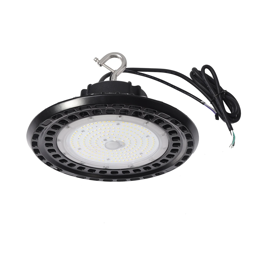
Residential projects sit across this whole range; kitchens and baths benefit from high CRI LED lights while a garage doesn’t, but the commercial lesson holds: match the rating to the risk. A facilities manager choosing highbay lights for a warehouse and a retail buyer lighting a flagship store are making completely different CRI LED lighting decisions, and both are correct for their context.
How to Choose CRI LED Lighting for Your Space
Run every color-sensitive project through these steps, and you’ll specify for LED color accuracy instead of relying only on marketing claims.
1. Decide if color accuracy is mission-critical. Ask what happens if a color reads wrong. If the answer is “a sale is lost” or “a defect gets missed,” you’re in high CRI lighting territory. If it’s “nobody notices,” 80 is fine.
2. Choose the appropriate CRI range. Use the tables above: 80 for general spaces, 90+ where color quality in lighting is visible and valued, 95+ for reference-grade work.
3. Match the color temperature. Lock in the CCT the space calls for: warm for hospitality, neutral-to-cool for retail and industrial, remembering that CRI vs color temperature are independent. You can have a warm 3000K product with a 90 CRI rating, or a poor one; check both.
4. Verify lumen output. Confirm the fixture actually delivers the brightness the space needs. This is the CRI vs lumens discipline; never let a high CRI rating distract you from checking foot-candles.
5. Look beyond the headline CRI. Check R9 and TM-30. Standard CRI averages only eight pastel test colors and skips saturated deep red (R9), which is exactly the color that makes skin, wood, meat, and brand reds look alive. A light can post CRI 90 with a weak R9. For color-critical jobs, request the R9 value (aim for 50+, ideally 90+) and, where available, IES TM-30 fidelity (Rf) and gamut (Rg) data for a fuller picture of light color rendering.
6. Confirm efficiency, controls, certifications, and fit. Check efficacy (lumens per watt), dimming capability, and certifications such as ENERGY STAR or DLC, which are relevant for rebate eligibility through the utilities across North America, and then for demanding industrial applications, confirm that the fixture type, mounting method, efficiency, and specifications match the project requirements. This is the only way to distinguish decent LED lighting quality from good specifications.
In the event that you need to compare different types of LED lighting for residential, commercial, retail, or industrial applications, Mesla Lighting provides high-efficiency lighting systems with well-defined values of CRI, color temperature, and lumens. Visit the Mesla Lighting website to learn more about our lighting systems or ask us for assistance in choosing the correct one.
Final Thoughts
The CRI lighting is the little specification that ensures the final result matches all the expectations people have had. Light intensity and warmth become everyone’s favorite specifications, but it is the color rendering index that saves sales, the reputation of the brand, and relations with the customer from a “Why does it look so wrong?” callback.
Set yourself the minimum CRI rating of 80 for commercial projects and choose high CRI lighting solutions that deliver better color accuracy, visual quality, and reliable performance across different applications. And always read past the headline CRI rating to R9 and TM-30 on color-critical work. Do that, and every CRI LED lighting choice you make will hold up under scrutiny and under the light.
FAQs
What is a good CRI for LED lights?
For most commercial spaces, a CRI rating of 80 or higher is the accepted baseline. For any environment where color matters, retail, hospitality, healthcare, food- 90+ high CRI LED lights are the better call.
Is 80 CRI good enough?
Most times, yes. An 80 CRI rating will give you good color rendering in the workplace, classroom, warehouse, and commercial business settings. However, it fails if accurate color is required for decision-making or impression.
Is 90 CRI considered high?
Yes. A rating of 90+ CRI indicates that the lighting is beginning to be high CRI, where colors appear vibrant and accurate. This is the practical sweet spot for CRI LED lighting.
What is the difference between CRI and color temperature?
They measure different things. CRI and color temperature are an example of precision vs. perception: CRI measures the fidelity of colors in terms of a 0 to 100 scale; color temperature, measured in Kelvin, measures whether the light is warm or cool in appearance.
Does CRI matter for LED lights?
Absolutely. Because LEDs vary widely in color accuracy, the color rendering index is one of the most important indicators of LED lighting quality, especially anywhere colors must look right.
Is CRI 90 better than CRI 80?
For color quality in lighting, yes, 90 renders colors more accurately and vividly than 80. But “better” depends on the application; paying for 90 in a storage room adds cost without visible benefit.
What is CRI 95+ best for?
Reference level applications: art galleries, photography and videography, color matching between print and paint, and luxury retail, where natural color light is almost required.
Is a higher CRI always better?
No. The better the CRI, the more effective it is at reproducing light colors, although a high CRI value alone doesn’t amount to anything if other parameters such as lumens, color temperature, R9, or efficiency aren’t in line with the space requirements.